
Pike Federal Custody Scope
No separate ICE detention center, federal prison, or U.S. Marshals contract facility in Pike County was found in the reviewed official local inventory. That is a bounded finding from the research date. It does not establish that temporary federal holding or a future arrangement can never exist.
The key Pike County event is often a transfer out of the county detention center. The sheriff’s booking or release record should identify whether ICE, USMS, another jail, or another authority accepted custody. If so, the person left Pike’s booking but was not released to the community. The receiving system controls what happened next.
Search ICE Detention Status
The ICE Online Detainee Locator System, or ODLS, is primarily a current-detention tool. Search by full name, country of birth, and date of birth, or use an eight- or nine-digit A-number. The A-number is the stronger identifier when available.
- Confirm that ICE, rather than BOP, USMS, MODOC, or a county jail, is the likely agency.
- Search by A-number and country of birth when the number is known.
- Otherwise use the full name, country of birth, and date of birth.
- Record the facility or status shown and the date of the check.
- If no result appears, contact the appropriate ERO field office rather than assuming release.
A no-result can reflect release, transfer, removal, a spelling or identity mismatch, delayed data, or a person who is not eligible to appear. ODLS is not a durable historical release archive. It cannot, by itself, establish when or why ICE custody ended.
Confirm Immigration Release with ERO
ICE Enforcement and Removal Operations field offices are the contact path when ODLS does not resolve current custody. Use the ERO field-office directory and provide the A-number, full name, date of birth, country of birth, and any known facility or transfer date. Ask a custody-specific question.
ERO may clarify a transfer or current location, subject to privacy and disclosure limits. A person’s absence from ODLS can never be turned into a claim of community release without further confirmation. If Pike jail was the sending facility, retain its transfer entry alongside the receiving-agency response.
Use the official field-office directory
Provide A-number and identity details
Include known transfer date and sending agency
Ask whether custody is current, transferred, or ended
Note: ODLS is current-focused, so an ERO confirmation is more useful than interpreting a vanished search result.
Check Immigration Court Records
The Executive Office for Immigration Review maintains Automated Case Information. Search by A-number to review available immigration proceeding information. The EOIR case portal and hotline at 800-898-7180 report case status, not detention status.
A hearing date, decision, appeal, or case status can explain the immigration proceeding but does not prove where the person is held or whether physical release occurred. Pair the court information with ODLS or ERO. This prevents a legal case update from being mistaken for a custody event.
The official EOIR portal appears in the successful Pike federal-immigration source capture below.
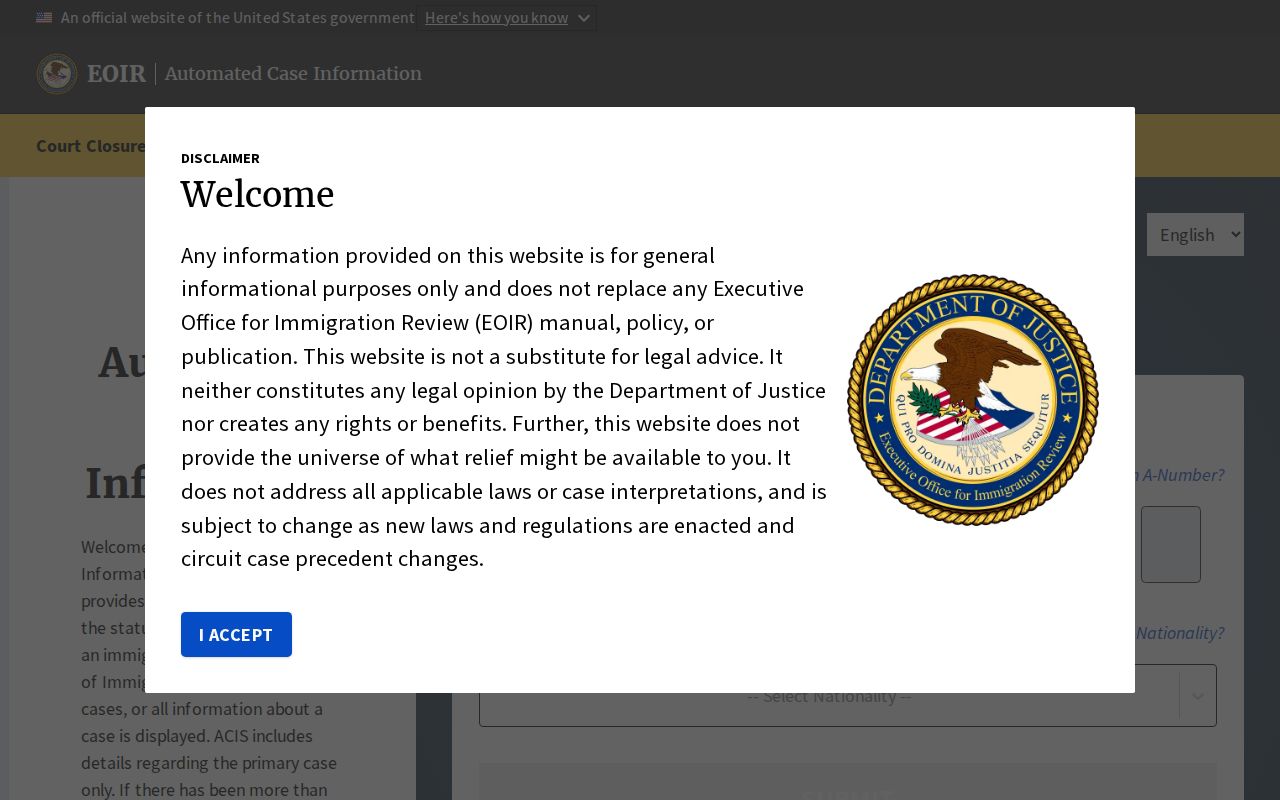
The portal’s proceeding data is valuable context, while ICE remains the source for immigration detention and release confirmation.
Check USMS Federal Releases
The U.S. Marshals Service can hold and move federal detainees, but it has no public recent-release list. For a federal criminal detention connected with Pike County, search PACER for the correct district and case. Review detention, bond, release, dismissal, judgment, and supervised-release entries.
A court order establishes legal authority and conditions, though it may not show the exact hour that USMS completed a movement. When an existing custody record is needed, submit a narrow USMS FOIA request with the name, identifiers, date range, district, case number, Pike connection, and requested detention, transfer, or release record.
Privacy and law-enforcement exemptions can restrict disclosure. Ask for an existing record rather than an explanation or a custom report. The federal docket and marshal record should be read together when the court action and operational movement occurred on different dates.
Federal Immigration Release Channels
Each federal channel has a narrow purpose. Selecting the wrong one can produce a valid result that answers a different question. Start with the agency shown on the Pike transfer record, then move through that system’s custody and legal records.
| Channel | What it shows | What it cannot prove alone |
|---|---|---|
| ICE ODLS | Current detainee location or result when available | Historical release date after a no-result |
| ERO | Agency custody clarification, subject to limits | Federal criminal court disposition |
| EOIR | Immigration proceeding status | Physical detention status |
| PACER | Federal detention and release orders | Exact operational exit time |
| USMS FOIA | Requested marshal custody and movement records | Automatic public recent-release feed |
BOP is a separate federal prison channel. A BOP “Released” result describes BOP custody, not ICE or USMS status. Keep prison, marshal, and immigration records separate even when the same person appears in more than one system.
Pike Immigration Transfer Records
Begin the local handoff with Sheriff Stephen Korte’s official detention source, compare the Pike Circuit Clerk record, and use the Pike Judicial Circuit Court contact for a local order. ICE, EOIR, USMS, and PACER then answer separate federal custody or proceeding questions.
Ask the Pike County Sheriff’s Department for the booking and release or transfer entry when a person disappears from the local app. Give the full name, date of birth or booking number, and approximate date. Request the event time, event type, destination, and receiving agency. A destination naming ICE or USMS changes the next search path.
The official Pike sources did not verify an ICE detention contract, local federal facility, or public county recent-release archive. A missing app name is therefore weak evidence. It may mean a community release, state transfer, federal transfer, another county placement, delay, mismatch, or booking change.
The Pike detention release page gives the county-side confirmation steps. Once the sheriff identifies federal or immigration custody, return to ODLS, ERO, EOIR, PACER, or USMS based on the receiving agency.
Reconcile Immigration Release Results
First identify the last verified custodian. Second, record the exact event label, such as transfer, no locator result, release order, proceeding decision, removal, or custody ended. Third, seek the durable record that fits that event. No one portal answers all three questions.
Identity matching is central. Names may vary across the sheriff record, ODLS, EOIR, and a federal docket. Use date of birth, A-number, federal case number, and booking number to connect records. The A-number is especially important for matching ICE and EOIR information.
Dates can also differ. Pike may record the handoff time, ICE may update ODLS later, EOIR may post a case action on another date, and a court order may precede operational release. Keep every date tied to its agency and field. The Pike County released inmate search provides the wider custody-layer framework when state or local records may also be involved.
Federal Immigration Custody Overlap
A reported immigration release can have more than one legal setting. It may involve release from physical detention while proceedings continue, transfer to another facility, removal from the United States, or movement into another agency’s custody. EOIR case status may continue after detention ends. Conversely, a proceeding entry does not mean ICE has released the person. State only the event that the source actually supports.
Federal criminal and immigration processes can also overlap. A person may move from USMS custody to ICE after a federal court event. PACER can show the federal order, while ODLS and ERO address the immigration custody that follows. Neither system’s no-result should be treated as proof about the other. Use the A-number and federal case number to keep the two tracks distinct.
Immigration Release Recordkeeping
If a direct records request is needed, make it narrow. Identify the person, A-number or federal identifier, approximate dates, sending and receiving agencies, and the particular transfer or release record. Ask for existing records and available segregable portions. Privacy, security, and law-enforcement rules may restrict details, but a focused scope gives the agency a clear event to locate.
When records conflict, preserve the sequence instead of forcing a single date. The Pike transfer time, marshal movement, ICE intake, court decision, and later custody end can all be accurate. The result should say which agency’s custody ended, which agency took over, and whether community release was ever confirmed.
Does an EOIR case decision prove release? No. EOIR reports the immigration proceeding. Physical custody must be checked through ICE, and a marshal or criminal detention issue must be checked through the federal court and USMS channels.
Save each confirmation with its search date and identifiers. A later ODLS update may replace the earlier display, while an EOIR docket or PACER entry can remain. A dated record of what each official system reported makes later reconciliation more precise.
Public Record Search
Sponsored Results